 by
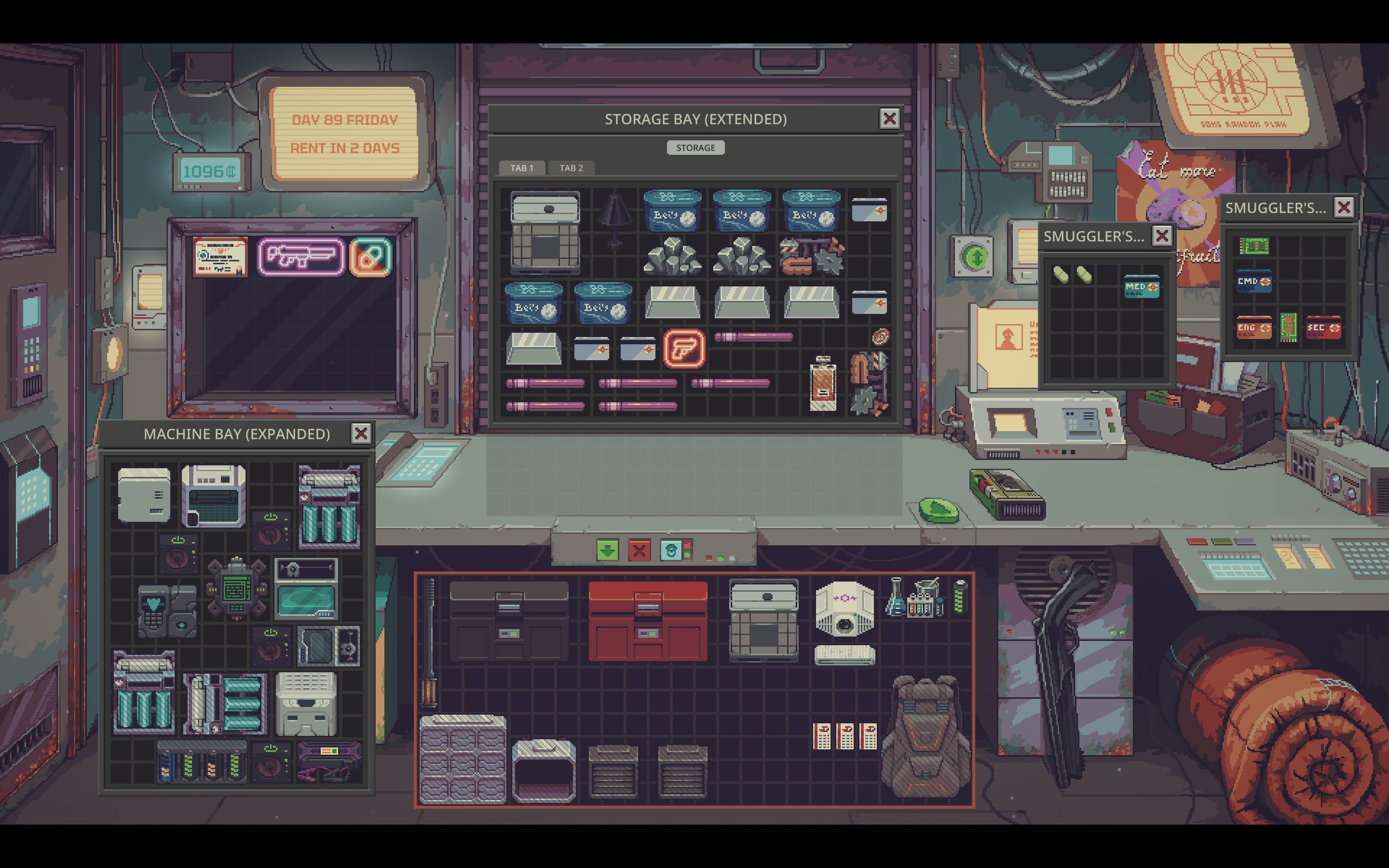
Probably Stolen combines inventory management, shopkeeping, a few minigames, and some light story elements in an effective way – able to keep me engrossed for hours at a time, with a whole host of subsystems to interact with – and yet, I find myself comparing it to idle games.
From Supermarket Simulator to TCG Card Shop Simulator to Schedule I, the shopkeeping-sim genre has been burgeoning lately – or perhaps I’ve just found myself consistently intrigued by their premises – and yet none have really kept my interest over an extended period of time. Fundamentally, they are all efficiency puzzles: you’re presented a system, asked to optimize it to maximize profit, then a new system is introduced or expanded to keep it fresh. Probably Stolen has this formula refined to a high degree: there are many, many subsystems you can choose to pursue, factions to influence, inventory to manage. I’ve apparently spent 16 hours with it, and there are few improvements I could suggest that I think would make the basic experience more complete – I haven’t even really engaged with several of the shopkeeping paths available.
And yet, I find myself wondering if I’m just wasting my time. What distinguishes management/crafting sim games like this from an idle clicker? One where you just click the right buttons before starting to build an empire based purely on what will mean you need to click less? And perhaps the answer really is: nothing. The fundamental building blocks of these games are not fun, and that’s kinda the point. You’re thrown into a situation where you don’t really know what is going on (and are usually deeply in debt or something similar) and over the course of the game learn the things you need to do in order to…stop playing the game. Learning and mastering those systems is the game. Depending on your degree of familiarity, difficulty settings exist to keep things “challenging” – but are really just slightly randomizing your starting conditions or adjusting the rate at which numbers increase.
At the risk of sounding like the mid-30s professional with less and less time for all my hobbies that I am, I’m forced to consider whether these games are really only good for wasting your time. After my time with Probably Stolen, I feel “accomplished” because I have a good understanding of the systems and could probably restart on a more difficult setting without much problem or expand into one of the several sales routes I haven’t yet pursued. And yet, even if I did, my experience would be essentially the same – and perhaps that’s the real issue.
Let’s compare these shopkeeping sims both to other “sim” games and to more story-focused games. There are “pure” sims like X-Plane where the enjoyment comes from actually learning skills applicable to real-life, as well as more arcade-style sims like Cities: Skylines (or any number of the Maxis Sim games) where the enjoyment comes from either the creativity you can apply or the ant-hill-like experience of ruling over a city designed just the way you like. On the other hand, we have story-focused games like Outer Wilds or any number of cRPGs – or even Kentucky Route Zero – where the point is to experience a story with varying levels of control over the story. With these comparisons, I think the failing of the shop sim genre (which I also extend to games like House Flipper or Powerwash Simulator) comes down to this: they sacrifice the plot and challenge of story-focused games but don’t really provide enough breathing room for creativity like a true sim would. There is little to no meaningful input, mechanically speaking.
Consider a sim game like Factorio or Cities: Skylines: you are provided an almost unlimited tableau to build in whatever direction you want and only have vague, generalized constraints to worry about (resources and monster attacks in Factorio or money and traffic in Cities: Skylines). This encourages creativity while stepping back to let the player challenge themselves. This, I think, is the hallmark of what defines a sim game: the constraints are general and more about defining the rules of the world than about specific goals you have to accomplish in a specific sequence. Compare this with shopkeeping sims: there may be plenty of “content,” but the path through that content is predetermined. If you pursue a water broker “career” in Probably Stolen, you will always end up making the same small variations of “optimal” water purification pipelines, you’ll still be dealing in materials supplies because there’s literally no advantage to specialization, you will always be working towards paying rent at the end of the week, and you will always be appraising those stupid plasma canisters – not because it’s inherently fun, but because it’s free money.
At the risk of complaining about an aspect I actually did enjoy in general, Probably Stolen also suffers from the Skyrim problem: you can be best friends with the Security force while supplying the Rebellion and buying from the Black Market the whole time (or, my favorite, streaming your store’s security footage to all of them at once!). There are no choices which require you to choose sides or make any sacrifices, or any constraints that would make appraisals at all difficult. The obvious contrast here, of course, is Papers, Please – where you can spend minutes agonizing over whether you should have let that person through, but knowing that arresting them let you buy food for your family that week. Yes, the small plotlines that arise in Probably Stolen are, in general, enjoyable – but also entirely meaningless long-term and disconnected from the shopkeeping efficiency puzzle. Let the butcher sell you meat? It’s okay, you have 100 rep with Security. Turn in the butcher? It’s okay, you just pay a small fee to assassinate him get him off your back later.
Probably Stolen does try to hold the line between its sim and story elements to keep things interesting. And while I certainly enjoyed most of my time with Probably Stolen, I think I have to admit that the fun/hour ratio isn’t high enough to justify it. As I learned during my anime project, a piece of media can be enjoyable – addictive, even – but outstay its welcome to the point that it no longer deserves to be called “good.” All good things must come to an end, but not because happiness is ephemeral or the heat death of the universe requires it (though I suppose that’s probably true as well). Good things must come to an end because at some point, they will cease to be good if they do not; if we were trying to hit all the cliches, “you either die a hero or you live long enough to become the villain.” In media, this doesn’t even necessarily have to do with quality suffering (though that’s the case in 99% of situations) – it’s our attention span as humans.
If you want to play Cities: Skylines, you do so because you want to make a beautiful/efficient/interesting city. If you want to play Outer Wilds, you do so because you want to have an existential crisis while solving physics puzzles. But in the middle are shopkeeping simulators: not mechanically interesting enough to warrant hundreds of hours building a system truly your own and not plot-heavy enough to warrant the time they take. Many are slop – simple 3D assets in a simple game engine, closely related enough that Waterpark Simulator, Supermarket Simulator, and Powerwash Simulator might as well have been made by the same team. Probably Stolen is not this: it has character, is well-designed, and is addictive enough that it forced me to introspect about the whole subgenre to articulate why I disliked it, but is still part of this unfortunate no-man’s-land of fun. Maybe still play it with this in mind, but Tier Three for me.