Assassin’s Creed Brotherhood

As gaming history progresses, it has always become more and more difficult for me to assess what a “good game” is, partially due to my own pre-established biased getting in the way, but moreso because the complexity and variety of video games increases with each year. Assassin’s Creed Brotherhood (as well as the entire Assassin’s Creed series) had me sitting here, scratching my head for just that reason. Is Assassin’s Creed Brotherhood a good game?


If I may digress just a touch, I will say that I was and still am to some degree a huge fan of the original Assassin’s Creed game. Back when I had played it for the first time, I was completely blown away–never before had I played a game with such a massive draw distance where not only was everything explorable, but where every building had been hand built so that it was scalable in a (somewhat) realistic manner. Buildings and characters looked good, the setting was not an overdone one, and the story was interesting. Add to that the controls were unique, smooth, and yet complex enough to perform some pretty exciting parkour moves. I was immediately hooked.


My memories of the original AC still live on fondly in my memory to this day.
Two games later and I’m sitting here playing Brotherhood with a sickening sensation building up in my stomach, all the while I’m asking myself bewilderedly, “Where did it all go wrong?” I believe I have the answer, but it is not a simple one, and as I must address the question with some tact, I beg your patience as I assess a few different concepts.


First, there is the concept of a mechanical transition from one game to another. I’ll be brief, but usually when producing games in a series, the mechanics of a new game should be relatable enough to feel like a continuation of the previous games, but also possessing signs of growth and improvement. Super Mario 1 and America’s Super Mario 2 are perfect examples of this. In SM2, you run with the B button and jump with the A button just like before, only now you need to learn how to pull turnips up from the ground, enter doors and clay jars, pick up weird objects and utilize them, as well as learning the difference between the 4 playable characters. SM2 is similar enough to SM1 to not be a foreign concept, but introduces new growth to the game that causes the players to think and grow themselves in the way that they interact with the game. Right from the beginning of Brotherhood I know exactly how to play the game, because the controls and mechanics are exactly the same as they’ve been for the last two games. Nothing is new, nothing will be new (this I know as I’ve played Revelations, the next game in the series) and the player will interact with the world in the exact same way they did in AC1. The difference is, that now instead of somewhat having your hand held in what you’re allowed to do, you *really* get your hand held in what you’re allowed to do. Fun.


Brotherhood is less a game and more of an interactive experience where you are meant to believe that you are freely playing the role of a character, but the moment you move a couple feet away from where the game wants you to be, it jerks hard on the invisible chain around your neck and forces you to follow the rails that were laid for you. Near the beginning of the game, you ride a horse with Ezio’s uncle. In what was a comical sight, I moved what must have been relatively 10 feet away from the uncle and the game desynced me because I wasn’t  walking along beside him like it cinematically wanted. After meeting with Ezio’s sister, you’re left to wander around freely to discover the estate–except you’re not. You’re demanded to go to three completely random locations and talk to three random people to perform three random acts that are completely pointless. I believe that they are meant to be a sort of tutorial, but do I really need to do a quest to figure out that pushing “B” gets me on a horse? Do I need to do a quest where I learn that pushing B lets me pick up boxes? What the heck?


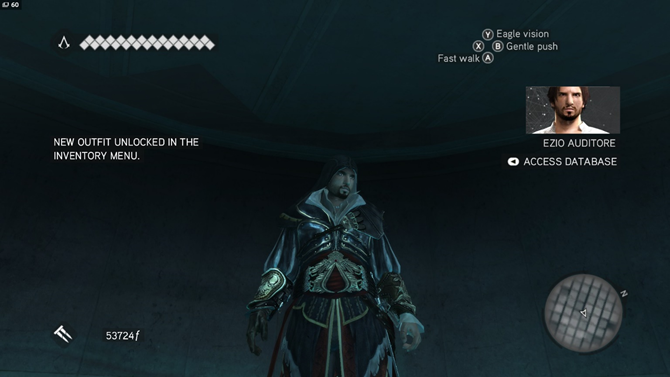
And sex. Ooooh, the sex. The first female character I met in the game that wasn’t my sister, implied about three different ways how she would provide Ezio with sexual favors because he carried a box of flowers for her–all the while Ezio is soaking it in, playing the role of “put yourself in my shoes, adolescent boys and play out my fantasies.” Not more than 10 minutes later, there is sex scene between Ezio and a different woman than the flower lady. Cleavage flops about everywhere and butts are taut on every female character except Ezio’s mother. Is sex inherently bad? No, of course not. Is an attractive female body wrong? Not at all. My issue stems from the reason for its use–which I know is only there to titillate the heterosexual male gaze and nothing more. I must stress again, that sexualized characters are not inherently bad–as long as there is a purpose beyond cheaply appealing to the chemical nature of a segregated portion of the gaming community. My wife and I love playing a game–it’s called “White man with stubble.” If the character of a game is a white man with stubble, then 9 times out of 10, the title is a shallow pandering to a male power fantasy, disguised as a game and cashing in on the straight desperate man-child. Brotherhood more or less falls into this category.

Classic victim of White Man with Stubble Syndrome:
 

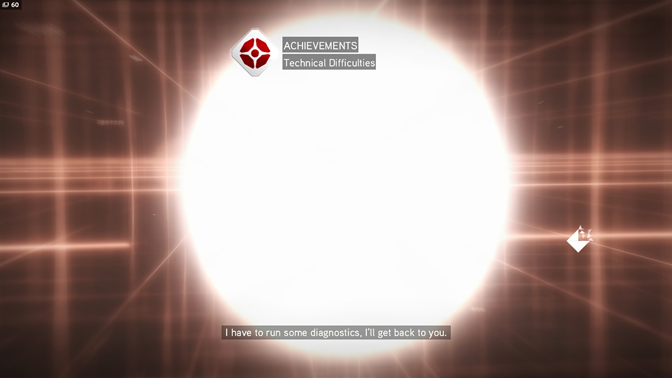
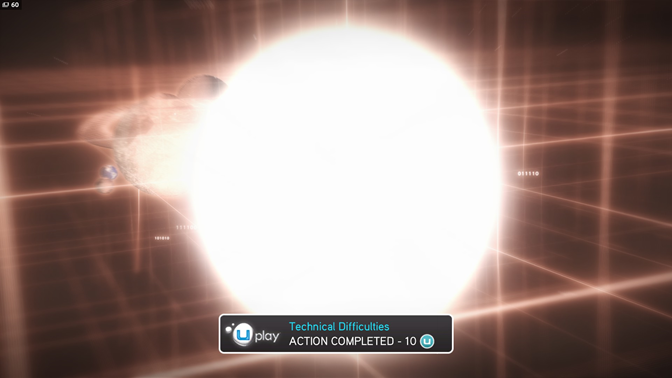
The pandering doesn’t really stop there either, as the game is filled with achievements for the most mundane of things. You literally get an achievement for watching the opening cinematic. Read that again. The game deems sitting on your butt and watching a cutscene, worthy of award. Is that how little faith they have in their own product? That they have to bribe the player into continuing to play their game through the use of cheap stickers for the most basic of tasks? What’s even better (or worse) is that every achievement you get, you gets displayed twice–once for Ubisoft’s joke-of-a-Steam-ripoff called Uplay, and once for what I assume is the actual game. Double gimmick points!
 

Now, with all this being said, to say that Brotherhood (and the AC series) is unsuccessful would be ridiculous. Ubisoft has turned the AC series into a powerhouse franchise that *has* to be raking in the dough. Do I fault them for that? No, not at all. It is simply that, just as each person has beliefs in what a video game should be, I as an individual also have beliefs in what a good game should be, and the AC series beyond 1 is not it. Instead of expanding their universe, mechanics, gameplay and ideas, it decided to focus more on a production of rapid-fire games in quick succession. Instead of growing a new genre of gaming that they nearly created single-handedly, they squandered it in order to play it safe. Instead of relying on the power of the entertainment value that they provide to their players as a catalyst for future game purchases, they instead rely on cheap gimmicks, sexual attraction, and hand-holding rail-roading so that they can appeal to the lowest common denominator. A game needs consequences, adventure, risk/reward and growth–both of the player-character and the player themself. Anything less is a manufactured product wearing the mantle of a good time.


I’m glad Ubisoft is releasing an AC movie. I think that’s where this kind product belongs (similar to my Kane and Lynch review). It belongs in a medium where the user is *expected* to sit around and do nothing. But to use video games as a medium into tricking the players that they are involved in something amazing, when truly all they’re doing is stagnating their own growth and imagination? No thanks. I’ve got indie games in my library that were created with a fraction of the budget that Brotherhood was made with that are more worth my time.

Steam Link


Vagante

I struggled with where I should put this game.  From my hour of play, it didn’t seem to be anything special – simply another roguelite set in a Spelunky-esque environment.  I died a few times – sometimes to spikes (an aggravating insta-kill – the only one in the game), sometimes to gigantic monsters, and sometimes due to my own ineptitude.  But while this has the usual trappings of a roguelike – e.g. Permadeath, constant danger, and randomly generated levels -it doesn’t have the same feel as you get from, say, Golden Krone Hotel.  I haven’t played enough to confirm this, but at a glance I would say that Vagante doesn’t have the same meaningful choices a roguelike needs to remain entertaining.  I was ready to put this into Tier Three, since I didn’t feel much motivation to continue to play this game.

Two things stopped me: First, this is an Early Access title.  I read some of the Steam reviews, and one fellow had over 1,000 hours into Vagante, proclaiming it one of the best roguelikes ever.  But near the end of his review, there was a note that it had changed since the time he had put in his time – mellowing it out and taking some of the special-ness from it, but making it more accessible.  That saddens me, but it also means that it’s possible it will improve just as much before it leaves Early Access – so it might be worth waiting.

Secondly, it seems to be a Co-op focused title.  My experiences were below par, but part of that may have been playing solo.  If you have a solo mode, good co-op isn’t an excuse for poor solo play – but it’s enough to make me want to revisit this sometime.

Steam link

Golden Krone Hotel

A roguelike set in a castle filled with vampires, monsters, and humans – and you can play as all three (sometimes in one playthrough!).

What makes this worth playing are the few unusual mechanics:

  • Windows let in sunlight and moonlight, hurting or healing you if you are a vampire or werewolf, respectively.
  • The humans are friendly if you are a human, and the vampires are friendly if you’re a vampire. You can get different bits of story from each.
  • Unidentified potions have three possibilities so you have some control over your risk-taking.
  • If an item you find is better, you equip it and sell the old one. If an item isn’t better, you just sell it – ridding the game of tedious inventory management.
Unfortunately – because it is a roguelike – it is a long and difficult journey. I had a lot of fun playing this for an hour and I would definitely recommend this to anyone who likes roguelikes… but there are enough of those on my list that I’m going to have to put this one on the back burner until I clear out more of my Steam inventory. It’s also still in Early Access, so coming back once more polish has been added might not be a terrible idea.
Creeper World 3: Arc Eternal

Creeper World 3: Arc Eternal is one of several sequels to a flash game I played on Kongregate.  It’s a modified Tower Defense game where you battle the “Creeper”: a mindless flood of indeterminate blue goo.  Emitters gradually fill the map with the Creeper (putting out layer after layer that slowly climbs the landscape), and it’s your job to survive long enough to collect the important resources and escape by placing cannons and energy collectors across the map.
I bought this game practically with the mindset of it being a Tier Two game (though we hadn’t come up with that yet): something I wanted to support the developers in because I enjoyed the flash game, but not something I really ever expected to complete.  It has solid core mechanics and dozens – if not hundreds – of levels (not including custom or random maps).  It’s unique enough to be interesting, but I’ve played enough of it to be satisfied (partly I played the flash game).  I’ll return to it when I have time or find myself wanting to play it again.

Steam link

Darkest Dungeon

A side-scrolling/turn-based adventure to clear out your inherited castle with some town upgrade elements thrown in.  It seems a solid game, but it has a gritty grimdark aesthetic which doesn’t quite click for me.
My only real complaints are these:

  • The narrator – who sets a wonderfully insane tone in the introductory cinematic – has a comment about every other action you take, which gets old before the introductory mission is over.
  • Single actions in combat take about 10 seconds to play out – slowing things to a crawl.
  • Due to the art style, buttons and actionable items blend into the environment and make menus seem crammed and unclear.

I may pick this up again in the future – especially if I can find an option to turn off the narrator (to be fair, I didn’t look while playing).  I do enjoy Lovecraftian horror, but the art style and combat pacing are too off-putting.

Steam link

Sethian

This game is simply brilliant and brilliantly simple.  There are two parts to your interface: the alien computer and your journal, which contains notes your character takes from their own intuition and from reading previous researchers.  The alien computer is in Sethian, a language deader than the planet you are on.  It’s your job to learn how to translate the language and solve the mystery of where the inhabitants of this world went.
At first, the journal holds your hand closely – telling you precisely what to ask the arcane machine and how to interpret the results.  As your knowledge progresses,your journal only tells you what to ask in plain English, requiring you to translate into Sethian and interpret the result.  I found myself translating the responses on my own before consulting the journal just for the challenge and practice.  Obviously, this isn’t a game for everyone – but if you like games like TIS-100, you’ll like Sethian.
An incredible part of what gaming can do is having you as a player develop, rather than your character.  It’s easy to just have your avatar progress and gain skill – increasing the numbers as you get new equipment or gain levels, but games that can level up you the player represent some of the best experiences in gaming.

[Edit 01/07/2017: the other fellows mentioned by your journal are authors, not alien companions]

Steam link

KnightShift

As I sat down to play KnightShift and began analyzing the content in front of me, I found myself soaking in the pleasant scenery, easily identifiable characters and heroic music, and I thought to myself, “For an older game, this isn’t half-bad. I should probably put this in Tier Two.” I then froze, looking down at my hands in disgust–the same way George Bailey looked at his hand when he shook Mr. Potter’s in “It’s a Wonderful Life.”  I realized in horror that this game… is garbage, and I had almost been tricked by it into thinking it was something good.
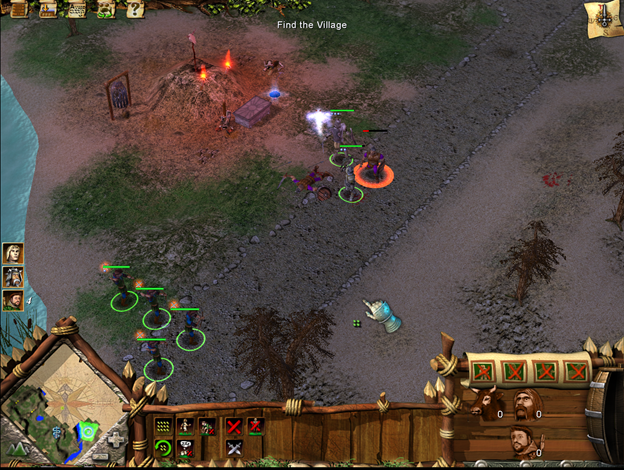
KnightShift is a hybrid RGP/RTS whereupon you control and (later on) can build units to use to fight against enemies in real-time, with a top-down view. Your hero units aren’t just stronger than the regular unit, but also possess the ability to gain levels as well as find and obtain better equipment. The game’s visuals are rather nice, with bright scenery and colorful characters. Controls and gameplay are mostly smooth, user friendly, and easy to understand. Characters are fully voice-acted, the action is relatively fast-paced, and the player knows exactly what’s going on at all times. So where’s the problem?
The problem is, is that this game is a trap. It traps you into thinking that you’re in a fantasy world with all the knights, monsters, “thou’s” and “thee’s,” and questing, but you’re not–you’re in a fantasy set, complete with fake wooden houses and cardboard cutouts. Fantasy is more than just looking like fantasy on the outside, it has to be fantasy–but you won’t find that in KnightShift. Prince John (the main character in the first campaign) is a Knight-Hero, simply because he needs to be in order to have a story. Wolves and bears attack you because they have to in order to create conflict. Wizards are only wizards because there needs to be somebody to cast spells. Townspeople have problems because there needs to be quests to waste your time, and divert you from the fact that the actual storyline of the game is shallow and nearly non-existent. In truth, once you have the mind’s eye to pierce through the colorful cut-outs and cheerful heroics, you realize that absolutely nothing in the game is happening at all–you’re simply on the rails of a rather flashy amusement ride that treats you like you are in danger, but you soon find that the ride’s restraints keep you from ever coming to any harm.
Unfortunately, the same is true for the gameplay and game mechanics as well. A true game has consequences, risks and strategy. KnightShift barely has any of these things. Actual fighting in the game comes down to clicking on an enemy and watching your heroes and any troops they have kill them. Then, you check your health bars and if you need to, you heal by sleeping if the bars are low. If you don’t feel like sleeping you can stand in a healing shrine. If you don’t feel like doing that, you can find the “extremely rare” blue mushrooms (NPC’s words, not mine) that pop up like daisies everywhere, that will heal you to full HP. There’s no technique, no skill, no brainpower used–simply click, watch die, move on. There’s only the barest minimum of micro in the game, which usually just comes down to “Are your archers in the back? Good. Are your heroes focus firing? Good. Did you pull back every so often to keep your melee units from getting surrounded (assuming they weren’t absolutely overpowering everything like they usually do)? Good.”
I understand every single RTS can’t be as refined and technical as Star Craft, but I’ve seen Diabloesques with more finesse than this piece of crap. At least in a Diabloesque I get the satisfaction of planning out how I’ll spend my levels, and what kind of character I want to build around certain skills. In this game, leveling up just pads your stats. It doesn’t change how you fight at all (if you can call clicking on a monster once “fighting”). Heck, you aren’t even allowed to manage your equipment–the game just automatically reads whether the equipment on the ground is better than what you hero currently has–if it is, it gets vacuumed up into the hero’s inventory and equipped. If not, it just gets left on the ground.
The only pseudo good thing about the game is at times, it has a bit of a sense of humor, and doesn’t try to take itself too seriously. Prince John is an overdone (for humor) Hero to a “T,” both in his tone and mannerisms of speech. NPCs are kind of silly and monsters are cartoony. However, I can only feel that this was just another attempt to hide the fact that there’s no game here whatsoever. Recently I complained that if you stripped everything away from Vessel, you’d be left in a room filled with switches and buttons, and you needed to figure out what order you needed to hit them all in order to leave. If you did the same thing with KnightShift, you wouldn’t even have that–you’d have a blank room with a single button that said “push to continue.”


There are just no consequences in this game at all. You can heal whenever you want. You will win, with the barest minimum of effort, whenever you want. You will never get lost, because the game prevents you from going in the wrong direction, through the use of closing doors, gates, and teleporters–and if ever somehow you could get lost, the game is always telling you what you need to do at the top of the screen, and often it even has where you need to go on the minimap.
This kind of gameplay and setting may appeal to some. I’ve met some gamers that don’t want to have to think when they play a game, they just want to be told that they are the hero, and they want to win over and over again with little challenge. I can’t respect that kind of desire from a gamer, but I will at least accept it. For me however, I will never be returning to this game. Borrowing the words of Egoraptor from his Sequelitis Zelda review pretty much sums it all up for me. Knighshift is a “predictable time-consuming mess, that asks you not of your sense of adventure, or even your wit, but instead of your ability to listen and follow directions,” and as such, it deserves no more of my time.

Steam link

War of the Human Tanks


Long do I yearn for the days of my youth where I found my feet firmly planted in Advance War’s Macro Land, surveying the fields after another hard-fought victory. Max at my right hand would sorrowfully mourn the loss of the allied fallen, while Andy at my left would excitedly proclaim that this is the perfect time to celebrate the victory with a BBQ! Those were good days.
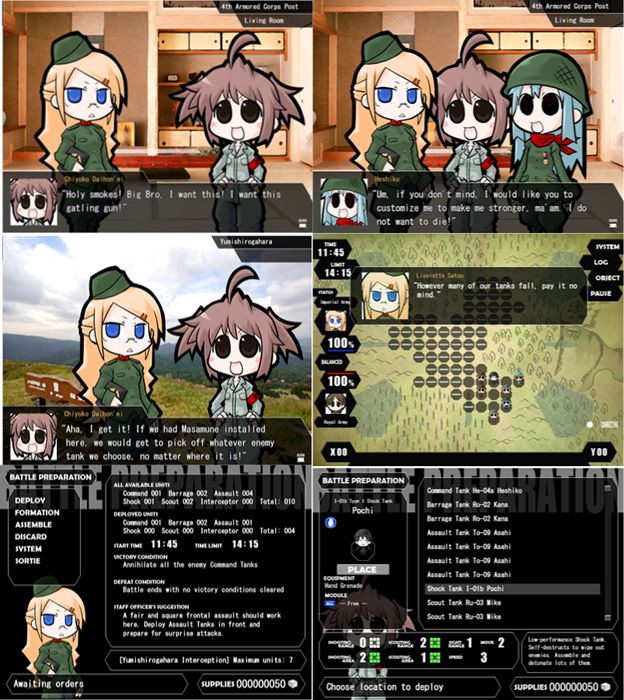
War of the Human Tanks is a strange mixture of this aspect of Advance Wars, with a little bit of Fire Emblem and your favorite quirky anime thrown in for good measure. It features a rag-tag regiment of military leaders who are loyal to the once-mighty “Empire.” Shoutaro, the “General from Hell” is their leader, a lazy boy who likes to watch anime. Then there’s Chiyoko, his little sister, who is an upbeat wiz mechanic. Next is the easily panicked Heshiko, a commander unit (more on that in a bit) that was modified by Chiyoko to be better than the standard battery. Last in the crew is Satou, a stiff by-the-rules lieutenant who is constantly upset at her regiment’s lack of structure and attention to detail. These characters on their own aren’t anything new, but they’re well-written enough to be amusing, especially when interacting with the lore of the world.
You see, WotHT is a world where machine-like humans are built to fight wars. Instead of being the traditional Japanese story of “What makes humans human?” or “Do machines that might as well be human deserve human rights?” the story and characters for the most part treat the Human Tanks sort of like lab mice–expendable and individually valueless–in spite of the fact that the Human Tanks actually possess emotions (albeit flighty and easily changed), are capable of intelligent speech and are completely adorable.
It’s this fact that brings one of the game’s greatest appeals–the Human Tanks are essentially an army of adorable little chibis whose greatest goal is to die on the battlefield before their battery runs out–they are after all, worth less than a human.  Pochi Shock Tanks charge eagerly to an enemy to fulfill their purpose–to explode and die. In spite of being one of the deadliest human tanks, Infinite-Range Artillery battery “Masamune” detonates after combat, simply because it is her time to die. Heshiko, an extremely skilled Commander Unit is given no rank or congratulations for her efforts because “Human Tanks don’t deserve a rank.” It may sound a bit cruel, but it’s all played up for humor. They’re so lemming-like that you can’t help but laugh; it’s similar to the humor created by the Minions from Despicable Me.
The gameplay itself isn’t too bad either–when you’re not clicking through text-boxes, you fight with your army on a hexagonal grid covered by fog-of-war. Your goal is to build your choice of Human Tanks from what you have available, choose their upgrades if you wish through the use of modules, place them on the map and then do your best to kill off the enemy with minimal losses, since the more of your army you keep alive, the less money you have to spend rebuilding them in the next mission. It’s simple enough to understand within a couple minutes, but contains enough choice of strategy that you can play to your favored style. I built my strategy off of intel, with many Mike (recon) units, and several Kana (artillery) units, but I could easily see how you could build an Asahi (close-range-assault) team, or maybe even a team completely made up of the self-destructing Pochis.
The game does have its flaws however. The beginning “cinematic” that plays out when you start a new game is completely confusing and frustrating to follow. Then, the following text-sequence that takes place at the beginning of the first level is also very disorienting, as the game doesn’t relay its setting, goal, or characters very well to the player–it just all sort of gets thrown at you like you were supposed to know what’s going on. Additionally, each level plays out like an anime episode since they all end with the credits rolling and a theme song. While this was clearly intentional, it confused me the first time I saw it, since any time you see the credits in most other video games, it means you’re at the end of the game. After you see them roll at the end of the second level though, it’s apparent what’s going on and so it’s not a big deal. Overall, if you can make it through the first ten minutes or so, you’ll understand enough to follow what’s going on, and from thereon it’s light-hearted fun.
I will definitely be revisiting this game in the future, and I look forward to seeing where the happy-go-lucky generals and quirky suicidal Human Tanks takes me. Intelligent Systems may never make another Advance Wars game, but this isn’t a bad replacement for the time being.

Steam link

The Curious Expedition

The Curious Expedition is a “roguelike expedition simulation set in the late 19th century” where you choose a hero, set out for an unknown land, and try to explore faster and better than your rivals from back in London.  Once you reach your unexplored area, it’s up to you to find the Golden Pyramid while managing sanity, time, and inventory slots.

It’s also an Early Access success story.  From what I understand, the developers had frequent and informative updates, finally delivering the complete game back in October – for which they are to be acclaimed and congratulated.

Unfortunately, after playing this game for an hour I felt no motivation to play further.  There seem to be many aspects of this game that interact in interesting ways, but how they work is not presented clearly – or barely at all.  And true, this is a roguelike.  Having clear explanations is almost unheard of in roguelikes (except for The Ground Gives Way, which has an excellent tutorial).  But I think the issue I was having can be explained with another roguelike: Caves of Qud.  Play an hour of CoQ and you’ll hear strange tales, see monsters lurking on every screen, die about twenty times, and drown in the atmosphere oozing out of every description.  After an hour in The Curious Expedition, I barely understand how to accomplish my goals – much less care about beating my rivals (whom you never interact with).  Every Expedition takes place in one of four biomes, and each time your goal is a Golden Pyramid somewhere deep in the continent.

If you’ll allow me another comparison, I’d direct your attention to Renowned Explorers: International Society.  If you look at the description and screenshots, you’d be forgiven for thinking that it’s the same game with slightly less pixelated graphics.  And you know what?  You’d be right.  In fact, many of the same mechanics are present in Renowned Explorers.  You choose an explorer, head to an unknown land, and try to find the quest items while managing time, inventory, and friendly relations.  The difference is that Renowned Explorers presents the information you need clearly and precisely – explaining its mechanics in about five to ten minutes of tutorial-ish gameplay.  Your team members are distinctive and lovable – making you care.  Your rivals actively try to sabotage you – giving you motivation.   Your combat options are more dependent on resource management rather than RNG – giving you options.

Again, I’m saddened to relegate this to Tier Three because The Curious Expedition could have been an entertaining foil to Renowned Explorers (though CE came out first). The Curious Expedition is an interesting example of a game with what I’d call an imbalance of flavor and mechanics.  If it had more flavor, I’d be interested in the story.  If it had purer mechanics, I’d be interested in the challenge.  Unfortunately, the elements don’t quite come together for me.  In my opinion, good games (or more specifically, good roguelikes) limit the RNG that directly affects your character – much like D&D.  The RNG should come entirely from the world you interact with, while your character – or party, in this example – is entirely under your control.

Steam link

Vessel

Switch puzzle/physics games have always had a special place in my heart. You can usually find them piled next to things like my mental versions of political figures I dislike, or my memories of Star Wars Episode II–you know, things that I like to take out every so often when I’m bored in my head and burn just for fun. It took very little time for me to determine that Vessel would be added to this pile.

Yes, I’m a little (maybe a lot) biased. I did just admit that I don’t like these kinds of games–but maybe let me explain a bit about Vessel and myself, and you may understand why.

Vessel is inherently a game where you play as some nameless white guy who runs around and hits switches and pulls levers. I suppose he has some backstory of being some great inventor, but it doesn’t really matter to the game at all. I could have been playing as Calvin, the bag-boy from the local grocery store, and the game wouldn’t have changed much. In fact, I think I’ll just start calling the inventor Calvin. At least it makes *me* laugh.

So Calvin is sitting in his lab, possibly reminiscing about his past achievements–the invention of a strange aquatic creature called “Fluorous”–when one of the Fluorous lock him out of his lab, leading him on an… “adventure” (by the loosest definition of the word)… where he must get back into his lab. Along the way, he’ll hit switches. He’ll open doors. He’ll pull levers and walk through more doors. If you’re lucky, you’ll get to spray water at something in random orders until, eventually, it might open another door. This inherently is the problem with most puzzle games in general but specifically Vessel–what is my motivation? What is my goal? Why do I care? I know nothing of the character, he isn’t that likeable, the Fluorous aren’t really interesting, and after 5 minutes I already know exactly the kind of game I’ll be playing.

“Oh, but what of the water physics? They’re neat, aren’t they?” I suppose to some degree they are, but what does it matter? I’ve never understood why physics justify the existence of a game. Physics are simply that–physics. Companies sell physics engines, but gamers don’t *buy* physics engines, and most puzzle games are essentially just that–an excuse to display a physics engine. If I wanted physics, I’d walk onto my porch a drop a rock off my balcony. “Does gravity still work? Yep, it does.” Fascinating.

One might argue that Vessel displays impressive, or at least “stylistic” artwork. To some degree, this is true–while the design did not appeal to me at all, I can recognize that work was put into the game’s visuals, lighting and layout. While the rooms are basically boxes with switches and buttons, they do try their best to appear interesting, with pipes running everywhere, cave-work in the background, and dynamic shadows/lighting. Yes, one might say that the game is “artistic” or “beautiful.” I could also tell you that the Sistine Chapel is “artistic” and “beautiful,” but I wouldn’t tell you that it makes the Sistine Chapel a good video game.

I guess the biggest crux I have with Vessel and most puzzle games, is that I have to ask the question, “Why?” Why would I want to do this? If you stripped away the graphics–if you stripped away the lighting and soothing music–the actual game “experience” is equivalent to someone locking you in an empty white room filled with buttons and switches, and a PA box overhead says “you can leave when you figure out how to open the door,” and at that point it’s up to me find the correct order to hit all the switches and pull all the levers. Yes, there are generally clues, and yes it exercises problem solving–but so does a textbook–and ultimately at the end of the day, I’m just implementing procedural inputs into a linearly designed path that I have to follow to get to the next set of required procedural inputs and on and on until I can finally see the credits roll. Being a stubborn gamer, I usually do just that–however this time, I decided to break the mold and find my own escape from the crushing loneliness of the underground steam maze.

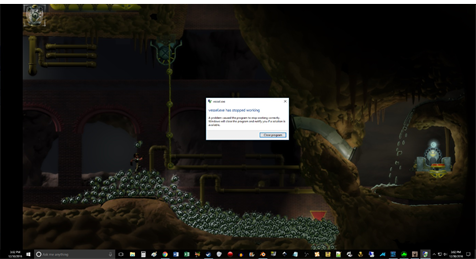
Once I obtained the ability to create Fluorous seeds, I soon discovered that the game allowed you to create an infinite amount of them–better yet, it did not despawn the old seeds. Thusly, I set out to see how many seeds I could create before the game crashed. In truth, I had more fun swimming through my seed sea than any experience I had solving Vessel’s puzzles. After 15 minutes or so, the game crashed, and I finally had my freedom.