 by
by 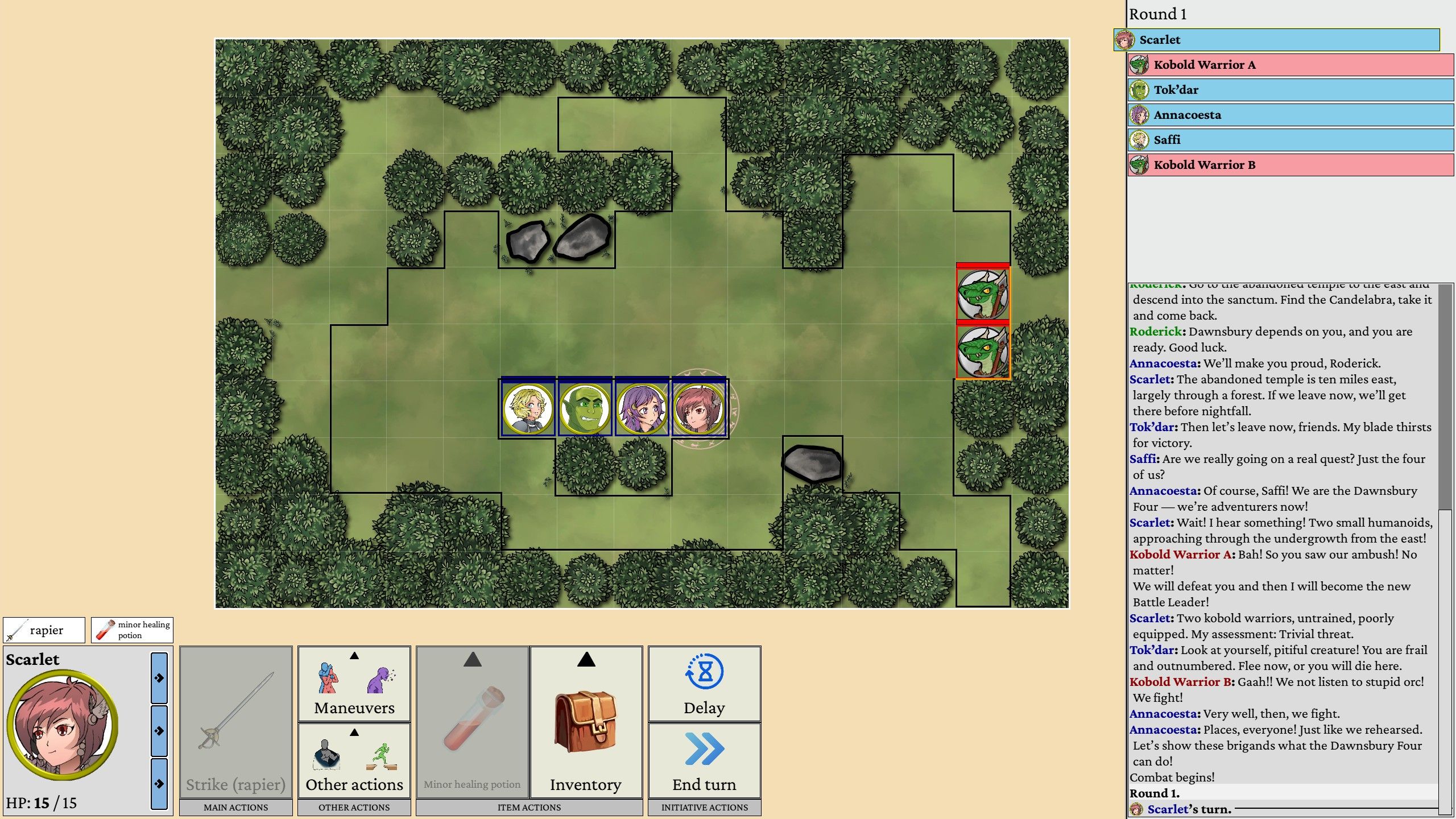
If you’ve talked to me about RPGs in the last two years, I’ve probably been singing the praises of Pathfinder 2e (… or The Halls of Arden Vul, but that’s another story): it’s well-balanced, has a functional economy, all the rules are freely available online, and – importantly for this review – the combat works. Remarkably, no major cRPGs have been made based on the Pathfinder 2e system, which is quite strange considering how well-suited it is for such a platform (and you’d think someone would have thought about it after seeing the success of Baldur’s Gate 3…well, other than the mad people who made a Pathfinder total conversion mod for BG3). As if to prove it, someone created a free-to-play game called Quest for the Golden Candelabra, and its success (at least in the Pathfinder community) was enough to inspire a full game sequel: Dawnsbury Days.
I was fully on-board with D&D Next as it became 5e, and was quite invested in the system up until the OGL scandal led me to look elsewhere. So understand that I say this coming from the viewpoint of someone who played and DM’d 5e for over 10 years: Pathfinder 2e is superior in every conceivable way, other than brand recognition. The balance is better, the character customization is better, the structure of turns is better, choices during combat are better, teamwork is better exists, the economy is better, the lore is better, the company is better – everything. The one area where people will argue Pathfinder 2e loses to D&D 5e is complexity, but this is a misconception (and perhaps memory of Pathfinder 1e, which … yeah, had a few too many things). D&D 5e does hide its complexity in DM overhead and conditional rules, but Pathfinder 2e is the simpler system both learning and actually playing (not to mention GM-ing). Pathfinder just confronts the conditional rules up-front and puts everything into boxes (and I’m not just talking about the trait/keyword system which makes everything easily reusable and reference-able).
Let’s take an example to show what I mean about 5e hiding its complexity while Pathfinder faces it head-on. You might hear that Pathfinder combat is more complex because you have to worry about four different types of bonuses during combat: proficiency, circumstance, item, and status – and all of those might stack together to give you a +1 from here, a +1 from there and so on and so forth. Compared to D&D’s claim to fame – advantage and disadvantage – this does seem more complex. But Pathfinder’s system is actually less complex – it’s just front-loaded so you’re prepared when those situations come up. Two of those bonuses I mentioned are going to be pre-baked into your character sheet (proficiency and item – which both also exist D&D), and the remaining two are quite conditional (circumstance being based on, well, circumstance, and status bonus being things like spells and the like). Really, in Pathfinder, you’re almost never going to have to worry about anything more than one (and rarely two) “source” of bonus.
In D&D, advantage and disadvantage sounds good in theory, but has flaws which make it far worse than the Pathfinder system. For example, advantage and disadvantage always cancel each other out – which means you might be 400 feet away from an enemy while invisible, prone, behind a wall, in a sphere of darkness, in a windstorm…but still easily targeted by their longbow because they also happen to be invisible (admittedly, resolving that situation in Pathfinder 2e would require two rolls – one flat DC 11 d20 roll to see if they target you correctly and one to attack you at -6 because of the range increment of the longbow). Now, you might argue that no sane DM will let things get to that point – that even though it’s RAW, the DM is meant to be the arbiter of “what makes sense.” But the DM has a lot to do all the time, and being asked to fix a broken combat system on the fly shouldn’t have to be one of those things: the rules you have written down in your books should actually work (this is true even in rules-light or “rulings over rules” systems – perhaps being even more important there, since there’s just fewer rules overall so you want the ones that exist to enrich the game rather than drown the GM). And if you introduce a Peace Domain Cleric to the 5e situation, there’s soon going to be all sorts of conditional bonuses to attacks – so my argument is that the 5e rules are not actually simpler and sacrifice verisimilitude in its attempt at simplicity.
But back to Dawnsbury Days: you might not believe me about the preceding paragraphs, but now I can point you to a remarkably well-made implementation of the PF2e system which will show you all the details that prove it.
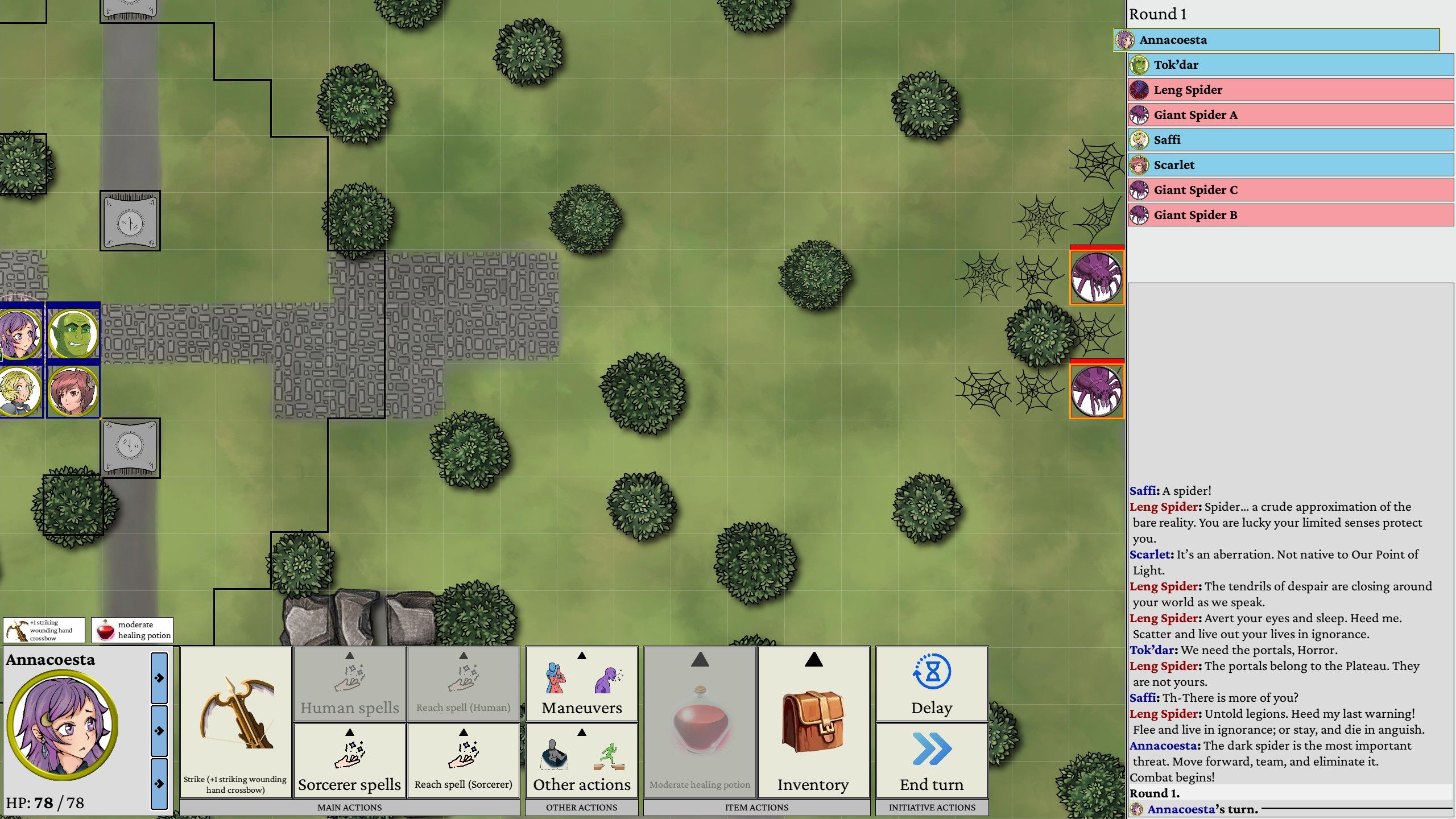
Dawnsbury Days doesn’t have the sort of purple prose and huge dramatic reveals that a game like BG3 has – it’s simpler, has quite a few inside jokes, is almost entirely combat-focused, and definitely feels like a smaller-budget game (though mercifully it also has a lot fewer characters trying to get in your pants). But in a way, it’s a much better representation of what playing an RPG actually feels like: if BG3 is Critical Role (mentioning them forces me to recommend The Glass Cannon Network as the superior podcast, however), Dawnsbury Days is playing an RPG with your college friends on a Friday night. And it costs about as much as chipping in for pizza – $5 for the base game, or $14 with all the DLC if you want to see how far the system can go after playing the free demo!
This was a mess of an article. I blame being out-of-practice and a huge Pathfinder 2e convert – but having now run PF2e for about three years since the OGL scandal, I wanted to recommend both the system and a fantastic little game built on top of it. Tier One, obviously.