Dark Messiah of Might and Magic (Completed)

First Impression

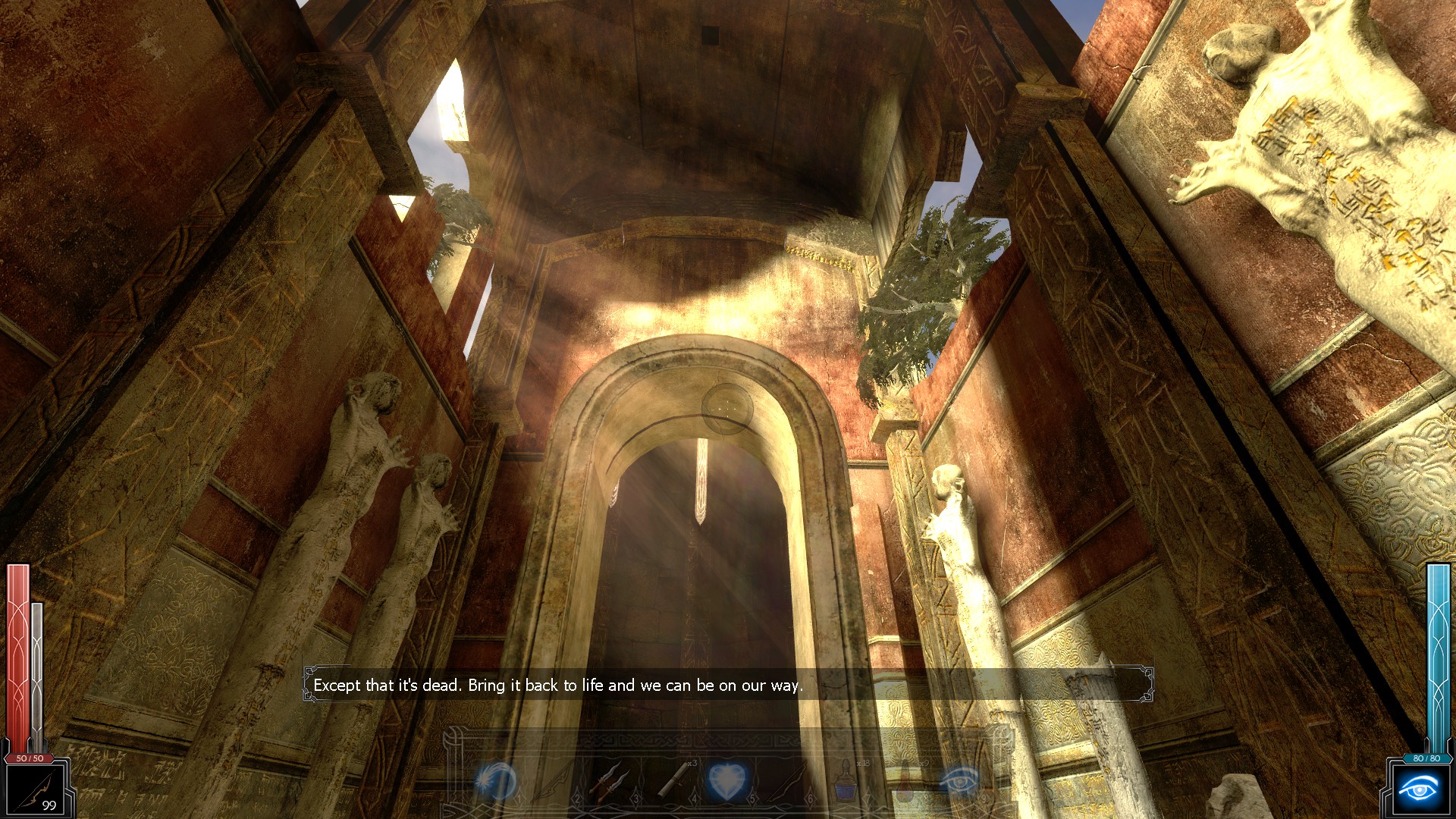
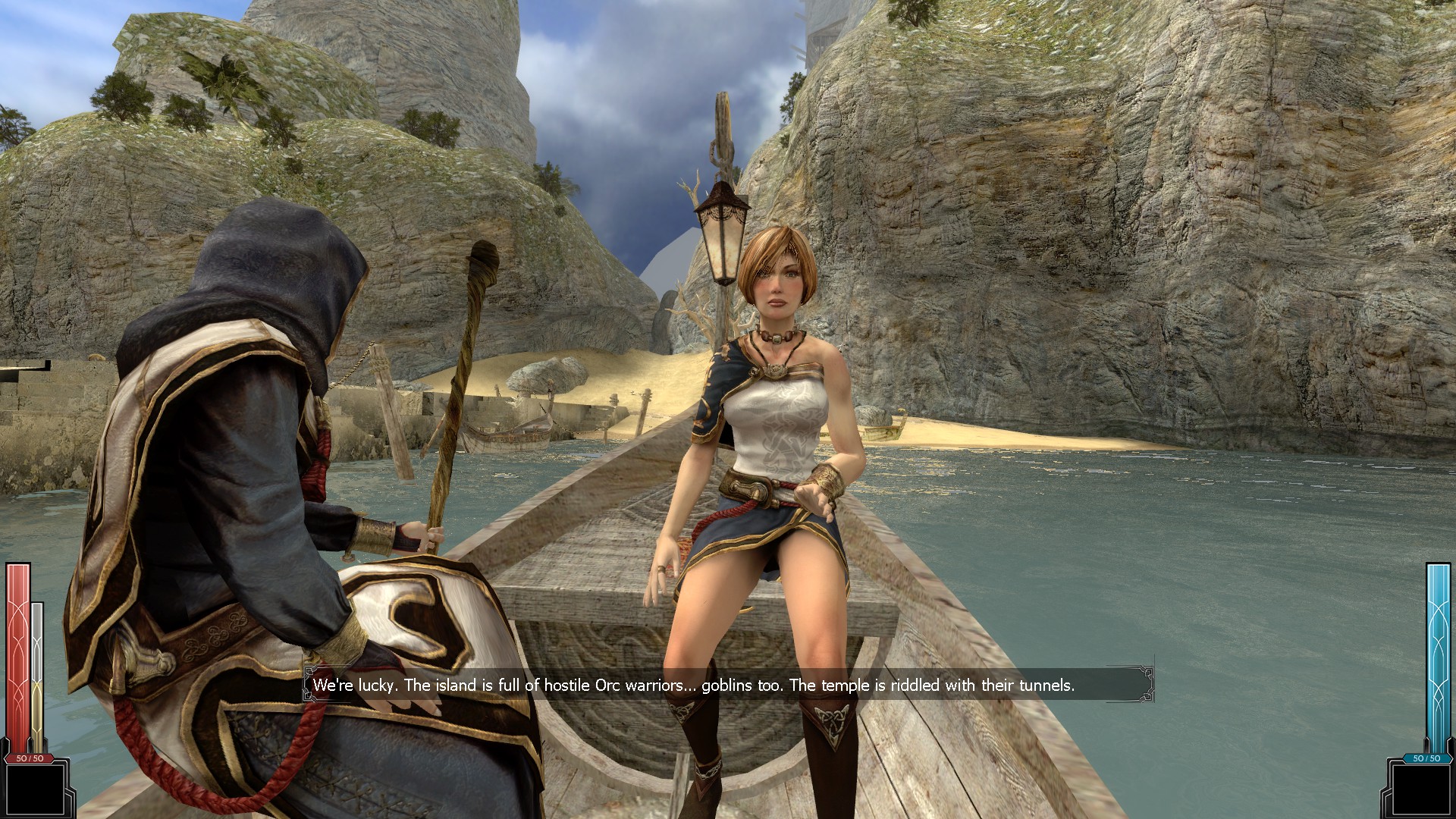
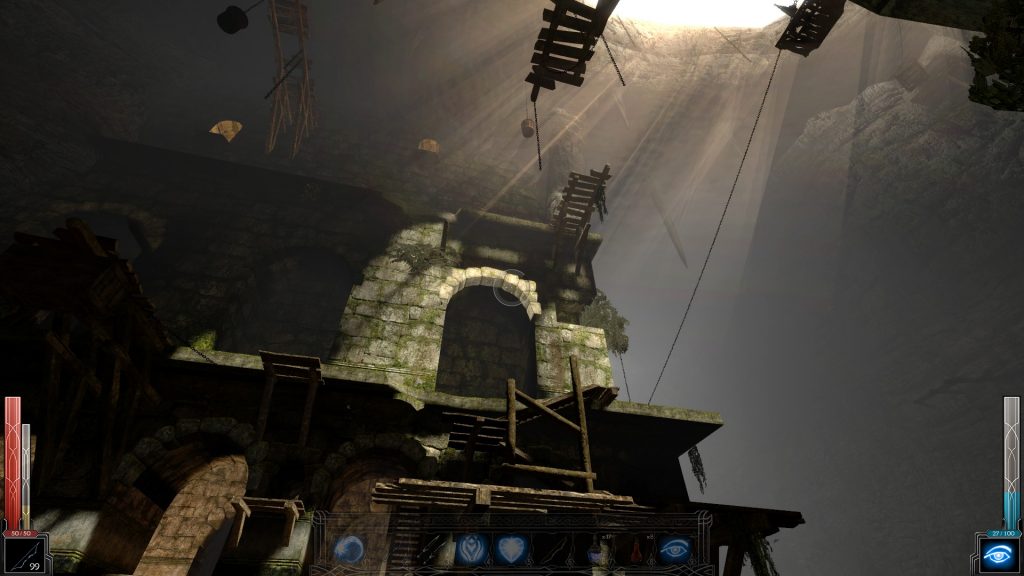
So I sat down over the weekend and finished DM of MM and I can say that it maintains its status as Tier 1 through to the end. I’m not sure if it cusped my mental “favorite games of all time” at any point, but it’s a solid game that even threw a couple curve balls at me that I had not quite experienced in an FP (First-Person) RPG before.


–Obligatory Spoiler Warning–


Overall, the story wasn’t anything to write home about. You play as Serath who is possessed by a demon–near the end you get the customary “good path/evil path” choice which affects minor aspects of the end-game. I, of course, chose the evil path because, (to quote Dark Helmet) “Good is dumb.” That and the evil path came packaged with a sexy demon. I suppose there are those out there who would’ve chose the young and peppy Leanna but frankly when I abandoned her in a prison and she turned into a Lich, I just laughed. Sound cold? It’s probably because you haven’t had to listen to her talk. The Succubus is hilarious by comparison.


The overarching plot is that Serath is the foretold Dark Messiah, bringer of doom or somewhat. Along the way, forces try to stop you–and I can’t say I blame them… I mean, you are sort of the villain in their eyes, even if you choose the good path. The final conflict comes in the form of a dual with a mighty Necromancer but… let me be real here. The combat–while fun–is not complicated and I won easily just by stun-locking him with my daggers. At the end of the evil path, you can choose to rule the world with your demon father, or with the Succubus that lives in your head. That decision was a no-brainer.


I’m assuming that there are roughly 4 endings to the game–2 divergent good and evil paths, each with the choice to join your father or not. I only bothered to get the ending where I joined the Succubus, but it was a bit lackluster (I imagine the other endings are likely to follow in suite). Essentially, Serath’s demon father zaps the Succubus, but Serath uses the power of the 7th Dragon’s Skull (it’s a McGuffin) to send his father back to hell. The majority of the cutscene is just your father talking about how he’s immortal and how he’ll seek revenge. It was a let-down, simply because you don’t get to see anything like Serath and the Succubus ruling the world together, or at least them celebrating in some way. Oh well.


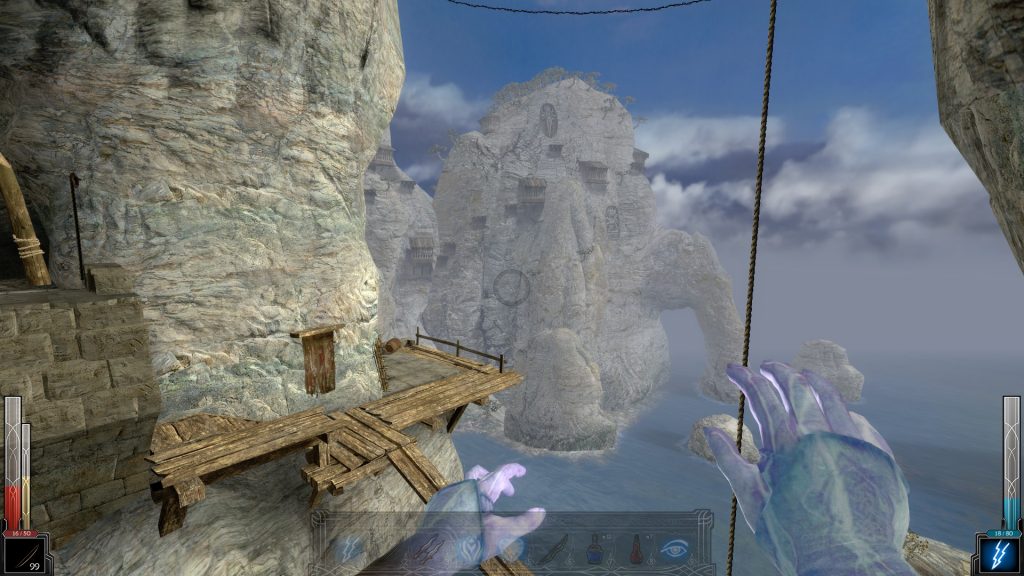
The real fun of the game comes from the levels and their design. The multiple-pathways thing that I mentioned in my first impression maintains itself pretty well through most of the levels and there are enough traps and odd hazards that even though you are never free from the reigns of the plot, it was still fun to jump around to all the nooks and crannies looking for secrets. At about the 25%-75% portion of the game is where it really feels the best. The designers start giving you some pretty cool items including a bow that shoots climbable ropes that you can use throughout the entire game, magical elemental weapons and stat-changing gear. The equipment is a bit sparce, but that just makes what you find all the more unique. Unfortunately though, at about the 75%~100% portion, the game just starts giving you the same stuff that you’ve likely found already, if you had a modicum of curiosity to find some of the game’s secrets.


I recommend it as a definite pickup if you like FPRGP’s, multiple endings and/or a plot light enough not to get in the way, but existent enough to give purpose for your adventure. I may pick up the game again sometime in the future and do a pure wizard run, or maybe restrict myself from using the healing spell to add extra difficulty. Either way, my memories of this game will remain positive in the future.


FEZ

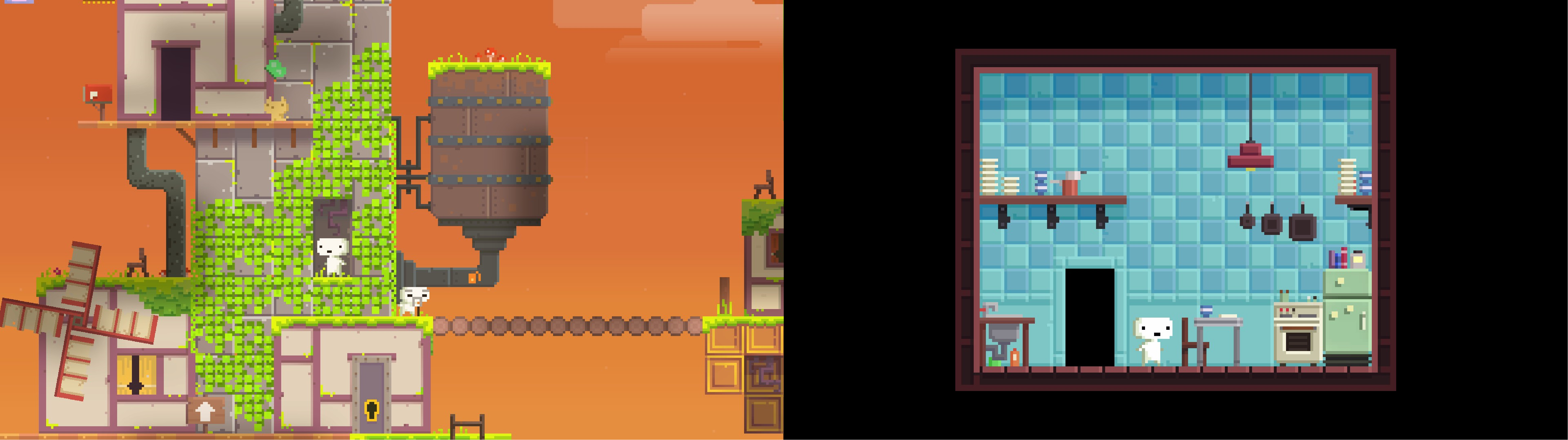
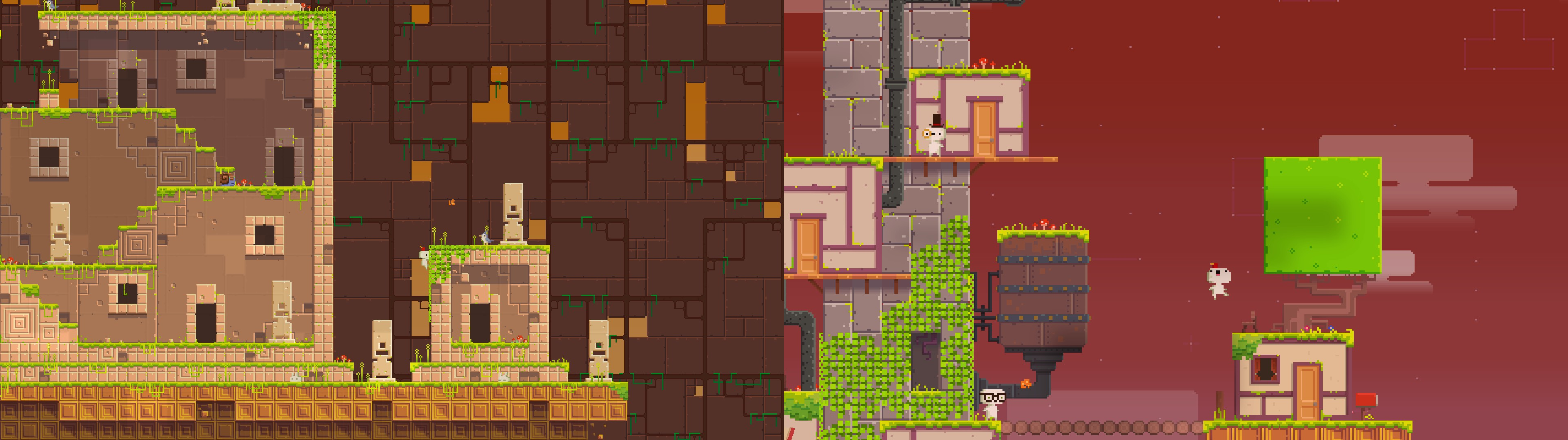
FEZ is a 3-D game with one game-altering twist. Instead of rotating your avatar (Gomez) and your camera around in the world you play in, you instead rotate the world around Gomez at 90 degree intervals while Gomez is always confined to two-dimensional movement upon the either the  X or Y and the Z axes. Aside from providing an interesting mechanic to allow problem-solving in a platforming setting, this also just provides an interesting method of understanding the perspectives of 2-D vs 3-D movement in general. For instance, there is a section with a seemingly endless ocean that you can swim across in a on-dimensional line. After swimming out for a minute or so, simply rotating your perspective of the world once will place Gomez right back at the island, since from a two dimensional perspective looking at Gomez in the opposite direction he was swimming in would indicate that he is right next to the island itself. The game does not increase Gomez’s size, accounting for size discrepancies however, since perspectively Gomez would appear to be larger compared to the island in the distance than he actually was (and perhaps that’s a game for another time) but as that would ruin the game’s mechanics, I have no problem with this.


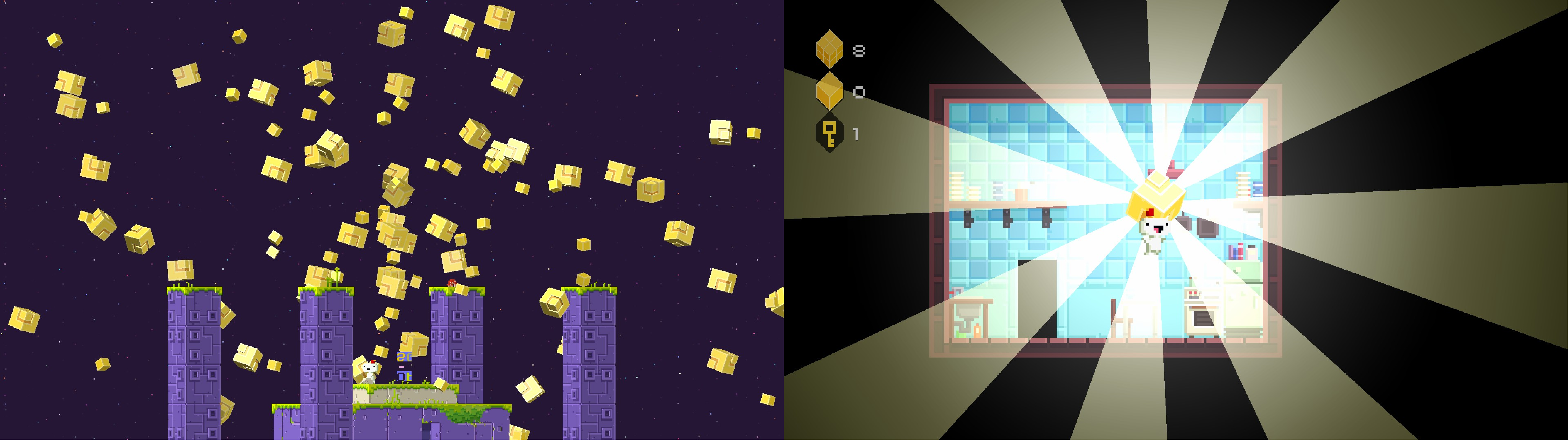
Plotwise, the world of FEZ is going to blow up because of the broken nature of three-dimensional movement impeding upon the two-dimensional and it’s up to you to collect 32 cubes (many of which are broken into multiple pieces) around the world. As far as I can tell, that’s pretty much it. There are no enemies, no villains, no spikes or catapults–it’s simply a game where you travel around quaint 2-D/3-D environments and collect cubes.


Now I’ll admit that so far, the game sounds a bit dull. In fact, while trying to critique FEZ, I underwent an internal struggle. If you haven’t heard before, I hate about 90% of the world’s puzzle games. As a whole I think they are a waste of time under the guise of a fun experience. When it comes to FEZ, two years ago I had actually played about 30 minutes of the game before–enough to identify it (incorrectly I admit) as just another 2-D puzzle game with a cheap gimmick that has no substance. While I can’t sit here and tell you that FEZ is a revolutionary product that breaks the boundaries of what a game can be, I also know that my initial analysis of the game was incorrect–the game isn’t really that bad. One problem I may have as a player is that when I play a game, I’m constantly looking for a challenge; I’m constantly looking to test my skills. Realistically, FEZ is not challenging. You have infinite lives, immediate respawns off any cliff you’ve fallen from and autosaves at every corner. However, If you slow down and don’t try to take it too seriously, it’s actually kind of fun. The game can be used as a sort of reprieve from complexity and its appeal falls in line with games like Mario 64 or Banjo Kazooie–the reward isn’t necessarily the defeat of another great enemy, but the collection of a piece of something resulting from the exploration of an interesting colorful world.


In the end, I realized that in some ways, the world may need games like this. Maybe I’m just feeling a little leniency from my usual harsher judgement of puzzle games. Maybe FEZ got lucky and in the moment I needed something a little slower-moving to provide a respite from the intensities of my usual challenging repertoire of games. Or maybe this challenge of Lepcis’s and mine is giving me a better appreciation and perspective over gaming as a whole. Regardless, I believe that FEZ needs to go into Tier 1, if only to remind stiff gamers like me that sometimes a game can be simple and relaxed, while still providing an engaging concept worth exploring. If you like Platformers that bend reality, this one might be for you.


Steam Link


Serious Sam – The Other Ones

The Second Encounter


I loaded this up, started out, and thought: “Hmm…this looks suspiciously familiar.  Like, exactly the same as the first game.  Hmm…yep.  Same desert, same oasis.  Though it’s raining this time.  Or maybe I just didn’t notice that the first time.”  Turns out, the Second Encounter was much like a DLC pack for the First Encounter.  And (on Steam at least) if you own both, the First Encounter levels are imported into the Second Encounter game.  Since The Second Encounter is basically more of the same, I’m sticking with my original assessment for this one – Tier One.

That being said, I do have one complaint I didn’t mention in my impression of the First Encounter that has grown to irritate me quite a bit while playing: most enemies teleport in – which means that you’ll frequently be attacked from behind by things that weren’t there five seconds ago.  This feels like a cheap way of increasing difficulty without really making things more challenging.  Having a single type of enemy do this or having it happen on certain levels would make sense.  But when it is the primary method of fighting, it grows tiresome after a while.

The Random Encounter


This is a 2D, turn-based RPG based on Serious Sam.  It’s a parody of Serious Sam, which is itself a parody – and it just doesn’t need to exist.  It isn’t particularly fun.  There are better ways to spend your time.  Don’t play it.  It goes to Tier Three, narrowly escaping Tier Four only because it isn’t aggressively bad all the time.

Serious Sam 2


The First and Second Encounters have a classic charm to them.  Sam makes occasional one-liners that are atrociously bad, but intentionally so – and it’s forgiven because it only happens sometimes.  Somewhat like old Duke Nukem.  There’s real challenge to be found (even ignoring the stupid teleporting monsters).  But in the SS2, there’s an inexplicable return of the lives system which hasn’t made sense since you could save your game.  The art is cartoonish and suffers from what I can only call early-2000s 3D syndrome, where everyone was trying to make things look cool and new, but ended up making games that have aged terribly – worse even than Classic Serious Sam.  This one, too, must be sent to Tier Three – though I may look at it again if I beat all the other games.

Serious Sam: Double D XXL


Why?  Why does Croteam think licensing Serious Sam out for cross-genre games is a good idea?  This time, it’s a sidescrolling shooter.  It doesn’t work well either – though better than the Random Encounter.  Within five seconds, I’m given two tutorial messages that completely stop gameplay.  I’d like to imagine Serious Sam from The First Encounter punching the robot telling you these things, especially when the robot even admits that it’s something Sam would already know.  It doesn’t make it better just because you’re being self-aware about it.  I know the things can teleport.  They just did.  Right in front of me.  Just let me shoot the things.  Tier Three again, but mostly because it pushed my game-hating buttons.  The actual gameplay might not actually be terrible.  I didn’t care to play long enough to find out.

Serious Sam Classics: Revolution


This is an indie remake of the original Serious Sam First and Second Encounters.  It’s different than the HD remasters.  No, I don’t know why there’s another one – though this one is in Early Access.  Once again, I find myself in a desert with a hidden area at an oasis.  It’s also raining this time.  It’s going into Tier Two because at this point, I’ve played the First and Second encounters enough, and this remake just doesn’t capture the same charm as the original for me.  Or I’m just tired of playing through Egypt.  The HD remasters are what you should play.

Serious Sam 3: BFE


Having played Doom, I was totally wrong in my guesses about what BFE meant, though I honestly couldn’t figure out the E (Egg? Echydna?  Exarch?  Eyes?).  Then I learned it was a prequel – so it stands for Before First Encounter.  That’s less entertaining than I was expecting.  Much like the game itself.  I started up a new game and was greeted by … Call of Duty?  Did I start the wrong game?  Oh.  oh…  On the plus side, after it got rolling, things improved and I was soon bashing and shooting my way through thick waves of classic monsters.  While I’m not sure I agree with the inclusion of such powerful melee attacks (almost prescient to DOOM, even), the early fights were satisfying and sufficiently challenging to pique my interest.

Of course, there’s a problem when they introduce the screaming fellows.  You know the ones.  If you don’t, you’ll soon come to love them (if you play this game).  The problem is, it’s the EXACT same moment as the First Encounter.  I believe Sam has the exact same dialogue.  And that’s really the problem I’ve been noticing with these games.  Croteam made 1.5 good Serious Sam games (since the Second Encounter was expanded DLC) and have just been repeating the same game ever since.  First they made SS2, but went too far afield.  Now, they are trying a return to form, though I’m not sure if it succeeds.  So for now, this too will go into Tier Two – since I think it’s probably worth picking up later, after I finish the HD remasters.

On an entirely unrelated note: Croteam’s later release, The Talos Principle, is worth a shot if you like puzzle games – very different than Serious Sam, but even better in its genre than the First Encounter.

Steam Links

Dark Messiah of Might and Magic


Completed Review

Dark Messiah of Might and Magic took me by surprise. When I think of the MM series, I typically think of party-built dungeon crawlers and tactical army-based strategy games. What I don’t think of are first-person RPGs—and yet not only is DMoMM (can we just call that DM?) a first-person RPG, it’s a great first-person RPG.

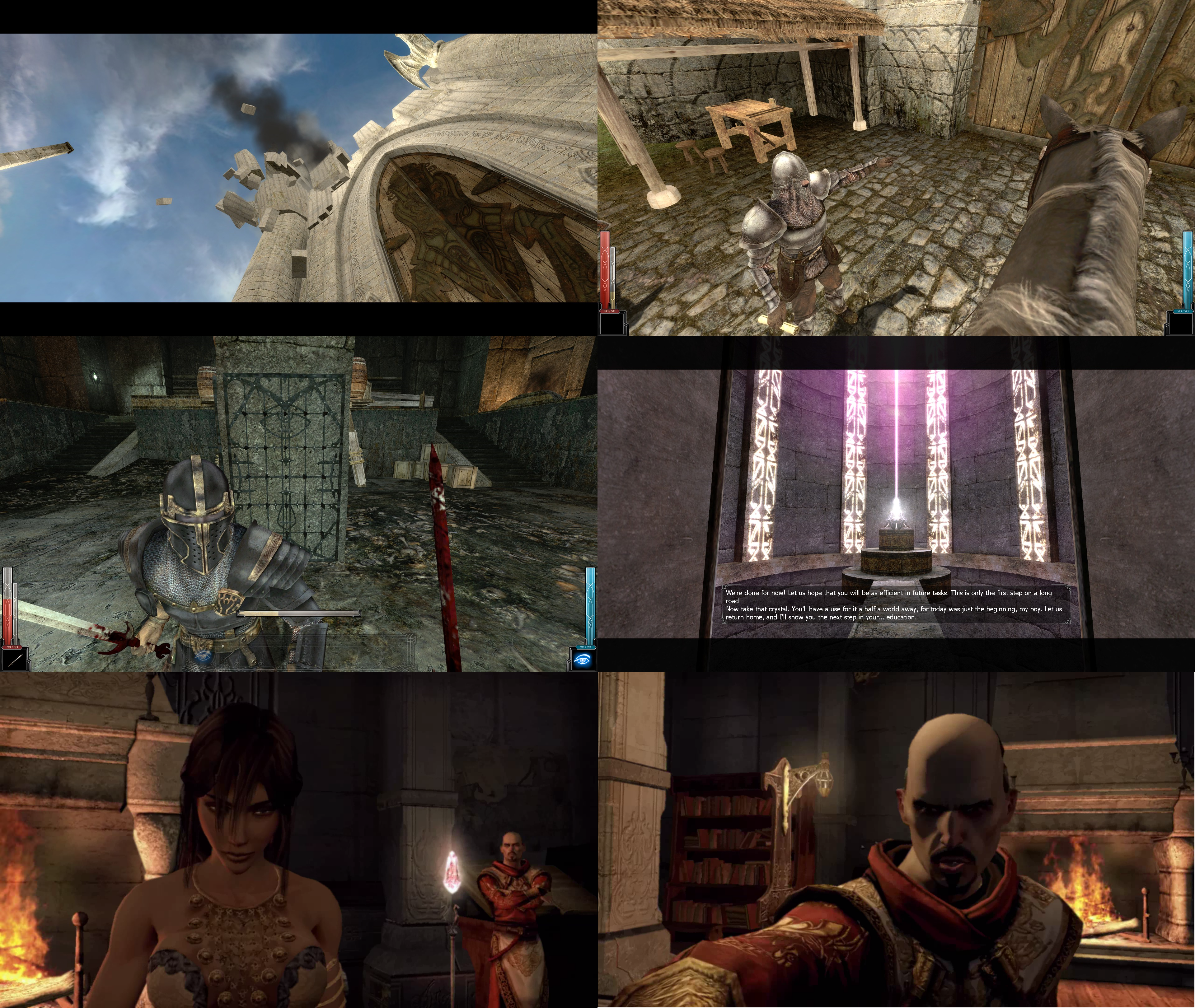
DM has everything a great game needs. Excitement, adventure, enough dialogue to keep things interesting, not too much dialogue to make things boring, mechanics that don’t just push the game forward but mechanics that are fun—for instance, one interesting feature is that you can always deliver a good strong kick in front of you with the F key. What can this be used for? What can’t this be used for! I’ve kicked people into fireplaces. I’ve kicked people into spikes. I’ve kicked zombies off of cliffs. I’ve drop-kicked pottery into a town guard’s head just for fun! Kicking isn’t just a strictly combative mechanical feature of the game, it’s built into the way you can interact with the world around you. A good strong kick (or a series of the same) will destroy a large portion of the architecture in the game and a majority of the objects are able to interacted with, or at least picked up and thrown. This means that the traditional combat of “block and strike” opens up into a wide range of feats in a 3-D world. You can do something as simple as throw a barrel at a knight, or find some oil, break it on the ground near a chokepoint and when in danger ignite it while running past to cover your retreat. You can lure guards to unstable storage structures and break the supports when they are underneath. You can pick up a teacup and chuck it at a ghoul because… well darn it, sometimes you just have a desire to throw the good china at the undead!

While progress in the game is linear, the levels are designed with enough secrets and multiple paths that in many instances you can choose your route. Combined with the destructive environment, and simple but distinct choice of weapons and skill paths, I felt encouraged to explore unique ways of fighting because the game seems to reward it all in an equally potent manner. Usually when I play a game, I find specialization in traps to be an overwhelmingly tedious task with underwhelming rewards. In DM though, I’ve not only discovered how to effectively use my fire trap spell, I’ve found that I love it! I feel excited when I’m running away from a pack of thugs and in my haste I have the presence of mind to throw down the trap in the middle of the doorway. The sound of explosions behind me usually signal that its done its job well. The collateral damage caused by the explosion just adds more fun to the chaos. Once, I found myself in an attic whereupon with each trigger of the trap spell, another portion of the floor boards were blown completely away, making combat with the remaining enemies a dance upon the remaining shifty rafter floorboards.

The environments of the game are nice, and despite being over 10 years old, the game largely avoids uncanny valley by not overstepping the bounds of its graphical design. The story and characters, while not particularly profound or engaging, are likewise not bad and provide sufficient motivation for the player while having a few interesting twists here and there. If I had one complaint, it’s that in spite of the well-designed nooks and crannies containing hidden treasure, I feel that too often the treasure is healing or mana potions. I would have enjoyed more unique rewards for my exploration (something along the lines of Lands of Lore II where almost every secret reveals something unique or rare) but the limited pool of weapons and equipment does keep the game from becoming a gear hunt and more of a check against your skill as a player with the equipment you have on hand.

From what little of DM I’ve played, it’s been a well-paced and simply a fun experience. Whether it’s finding the next hidden terrace I can leap onto through a window, or the next sweet explosion from a fire trap that destroys half the environment, I look forward to my future exploits in the game.


Steam Link


Serious Sam: The First Encounter

Sure, it’s basically Doom (no, not DOOM) crossed with Duke Nukem.  But you know?  Those were good games (well, mostly Doom).  Serious Sam: The First Encounter is a worthy successor.  Distinctive enemies (even if a couple of them are palette swaps), satisfying weaponry, and amusing dialogue make for a solid, fun game.

I want to briefly tell you about my first ten minutes: I have a habit of always trying to go the opposite way when a game starts.  Results range from the acceptable break from reality (the screen just doesn’t scroll that way) to the frustrating (Assassin’s Creed desync, I’m looking at you).  But Serious Sam?  I walk 45 seconds in the opposite direction.  A bunch of tough enemies spawn.  Ten minutes later, I’ve killed them all with my pistol and there’s a secret stash waiting at a desert oasis.  I was rewarded for trying something different (there was a slow health drain another minute out, but at least there wasn’t an instakill for not doing what the developers expected).

Before I even felt like I started, my hour was up.  I will definitely be playing more.

ICEY

If you haven’t played ICEY, you probably have one of two reactions: “ICEY?  Never heard of it.” which isn’t surprising, since it seems to be a somewhat small title.  But, as is more likely if you keep up with games news: “ICEY?  That’s the Anime Fighter Stanley Parable, right?”  And indeed, it is.

I went into ICEY expecting quite a bit based on the hype.  Initially, I was underwhelmed.  As a fighter, it’s not terribly difficult (though it does use a dual WASD and IJKL control scheme, which I think is kinda nice).  The Stanley Parable bits weren’t terribly exciting; though I probably wouldn’t have said that before the Stanley Parable came out, but now all games must suffer underneath the quintessential decision simulator.

As my hour progressed, I changed my mind – it’s still not terribly difficult (though a few boss fights have been challenging), but it’s a fine addition to the Parable-esque games genre: the hype having washed away, I was able to enjoy it for what it was.  And I ended up playing twice as long as I meant to: which is the whole point of Tier One, no?

Steam link

Sethian

This game is simply brilliant and brilliantly simple.  There are two parts to your interface: the alien computer and your journal, which contains notes your character takes from their own intuition and from reading previous researchers.  The alien computer is in Sethian, a language deader than the planet you are on.  It’s your job to learn how to translate the language and solve the mystery of where the inhabitants of this world went.
At first, the journal holds your hand closely – telling you precisely what to ask the arcane machine and how to interpret the results.  As your knowledge progresses,your journal only tells you what to ask in plain English, requiring you to translate into Sethian and interpret the result.  I found myself translating the responses on my own before consulting the journal just for the challenge and practice.  Obviously, this isn’t a game for everyone – but if you like games like TIS-100, you’ll like Sethian.
An incredible part of what gaming can do is having you as a player develop, rather than your character.  It’s easy to just have your avatar progress and gain skill – increasing the numbers as you get new equipment or gain levels, but games that can level up you the player represent some of the best experiences in gaming.

[Edit 01/07/2017: the other fellows mentioned by your journal are authors, not alien companions]

Steam link

War of the Human Tanks


Long do I yearn for the days of my youth where I found my feet firmly planted in Advance War’s Macro Land, surveying the fields after another hard-fought victory. Max at my right hand would sorrowfully mourn the loss of the allied fallen, while Andy at my left would excitedly proclaim that this is the perfect time to celebrate the victory with a BBQ! Those were good days.
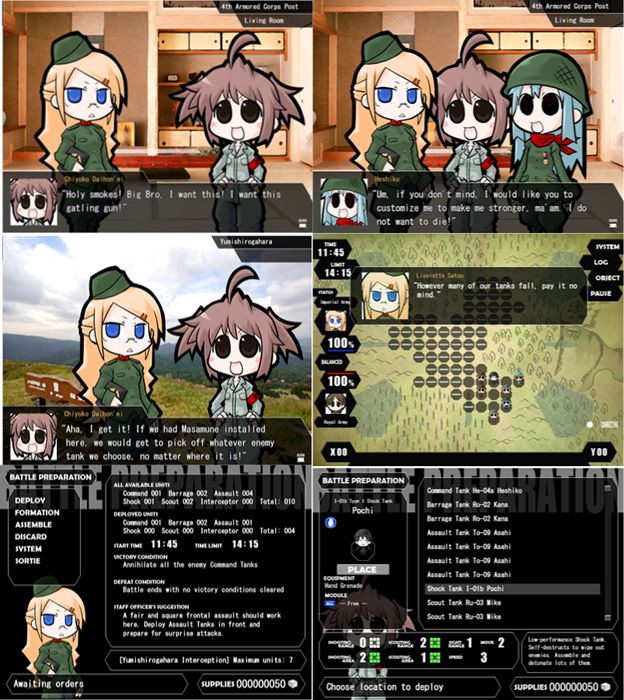
War of the Human Tanks is a strange mixture of this aspect of Advance Wars, with a little bit of Fire Emblem and your favorite quirky anime thrown in for good measure. It features a rag-tag regiment of military leaders who are loyal to the once-mighty “Empire.” Shoutaro, the “General from Hell” is their leader, a lazy boy who likes to watch anime. Then there’s Chiyoko, his little sister, who is an upbeat wiz mechanic. Next is the easily panicked Heshiko, a commander unit (more on that in a bit) that was modified by Chiyoko to be better than the standard battery. Last in the crew is Satou, a stiff by-the-rules lieutenant who is constantly upset at her regiment’s lack of structure and attention to detail. These characters on their own aren’t anything new, but they’re well-written enough to be amusing, especially when interacting with the lore of the world.
You see, WotHT is a world where machine-like humans are built to fight wars. Instead of being the traditional Japanese story of “What makes humans human?” or “Do machines that might as well be human deserve human rights?” the story and characters for the most part treat the Human Tanks sort of like lab mice–expendable and individually valueless–in spite of the fact that the Human Tanks actually possess emotions (albeit flighty and easily changed), are capable of intelligent speech and are completely adorable.
It’s this fact that brings one of the game’s greatest appeals–the Human Tanks are essentially an army of adorable little chibis whose greatest goal is to die on the battlefield before their battery runs out–they are after all, worth less than a human.  Pochi Shock Tanks charge eagerly to an enemy to fulfill their purpose–to explode and die. In spite of being one of the deadliest human tanks, Infinite-Range Artillery battery “Masamune” detonates after combat, simply because it is her time to die. Heshiko, an extremely skilled Commander Unit is given no rank or congratulations for her efforts because “Human Tanks don’t deserve a rank.” It may sound a bit cruel, but it’s all played up for humor. They’re so lemming-like that you can’t help but laugh; it’s similar to the humor created by the Minions from Despicable Me.
The gameplay itself isn’t too bad either–when you’re not clicking through text-boxes, you fight with your army on a hexagonal grid covered by fog-of-war. Your goal is to build your choice of Human Tanks from what you have available, choose their upgrades if you wish through the use of modules, place them on the map and then do your best to kill off the enemy with minimal losses, since the more of your army you keep alive, the less money you have to spend rebuilding them in the next mission. It’s simple enough to understand within a couple minutes, but contains enough choice of strategy that you can play to your favored style. I built my strategy off of intel, with many Mike (recon) units, and several Kana (artillery) units, but I could easily see how you could build an Asahi (close-range-assault) team, or maybe even a team completely made up of the self-destructing Pochis.
The game does have its flaws however. The beginning “cinematic” that plays out when you start a new game is completely confusing and frustrating to follow. Then, the following text-sequence that takes place at the beginning of the first level is also very disorienting, as the game doesn’t relay its setting, goal, or characters very well to the player–it just all sort of gets thrown at you like you were supposed to know what’s going on. Additionally, each level plays out like an anime episode since they all end with the credits rolling and a theme song. While this was clearly intentional, it confused me the first time I saw it, since any time you see the credits in most other video games, it means you’re at the end of the game. After you see them roll at the end of the second level though, it’s apparent what’s going on and so it’s not a big deal. Overall, if you can make it through the first ten minutes or so, you’ll understand enough to follow what’s going on, and from thereon it’s light-hearted fun.
I will definitely be revisiting this game in the future, and I look forward to seeing where the happy-go-lucky generals and quirky suicidal Human Tanks takes me. Intelligent Systems may never make another Advance Wars game, but this isn’t a bad replacement for the time being.

Steam link

Exanima


It’s Dark Souls but low-fantasy and isometric.  I haven’t completed my full hour yet (I have a feeling it’s going to take a couple to get a good feel for it), but for now it goes into Tier One – the atmosphere, music, and seemingly well-simulated world are quite enticing.